

How to Choose Industrial Pipe Fittings: 7 Steps
Quick Summary
To choose industrial pipe fittings, first define your operating conditions: the fluid or medium, temperature range, pressure including peak spikes, and environment. Then match the fitting material, pressure rating, size and schedule, and thread standard to those conditions. Verify certificates before ordering.
- Write down the medium, temperature, pressure and environment before selecting any fitting.
- Design for peak pressure events such as pump starts and valve closures, not only normal readings.
- Match the fitting material to the most aggressive fluid it will touch, including cleaning agents.
- Read the pressure-temperature derating chart, since ratings fall as temperature rises.
- Confirm the schedule and thread standard, because mixing NPT with BSP can cause leaks.
Table of Contents
- Start by Defining Your Operating Conditions
- Choose the Right Pipe Fitting Materials
- Match Pressure Ratings and High-Pressure Requirements
- Select the Correct Size Using a Pipe Fitting Size Chart
- Confirm Thread Types and Standards Before You Order
- Check Standards, Traceability and Common Selection Mistakes
- Plan Your Next Fitting Order and Installation Check
- Frequently Asked Questions
Start by Defining Your Operating Conditions
Last Updated: November 18, 2026
Choosing the right industrial pipe fittings starts before you ever open a catalog. Your operating conditions decide what the fitting must survive, and that should come first.
Start by writing down four things: the fluid or medium, the operating temperature range, the operating pressure, and the environment around the pipe. A fitting that handles cold water well may fail quickly in hot caustic wash-down lines.
- Medium: water, grease, wastewater, chemicals, or solids
- Temperature: normal, elevated, or cryogenic ranges
- Pressure: steady pressure plus any spikes during startup or shutoff
- Environment: indoor, outdoor, washdown, or corrosive atmosphere
Watch out: buyers often size for average conditions and forget peak events. A pump start or valve closure can push pressure well above the normal reading. Always design for the worst case you expect.
Industrial fittings are rated against recognized standards, so your conditions also determine which codes apply. The OSHA guidance on workplace piping and equipment safety is a useful starting point for facilities that must document compliance.
Choose the Right Pipe Fitting Materials
Material is the most important choice you will make. The wrong material causes corrosion, weakening, and leaks long before the fitting reaches its rated life.
Carbon steel works well for many dry, non-corrosive lines. Stainless steel, especially 316 grade, handles moisture, mild chemicals, and food-grade applications much better. Plastics such as PVC, polypropylene, and PVDF suit many chemical and drain applications where metal would corrode.
- Carbon steel: strong and cost-effective for dry or oil-based service
- 304 or 316 stainless steel: better corrosion resistance, common in sanitary work
- PVC and polypropylene: good chemical resistance at lower temperatures
- PVDF: strong chemical resistance for aggressive fluids
Check chemical compatibility charts from the material supplier before you commit. Match the fitting material to the most aggressive fluid it will touch, including cleaning agents.
Match Pressure Ratings and High-Pressure Requirements
Every fitting carries a pressure rating, but that rating is not a single fixed number. It is established at a reference temperature, and it falls as temperature rises. A carbon steel fitting rated for a high pressure at ambient conditions may carry substantially less when the line runs hot, and the drop is not linear across the whole range. Read the manufacturer's pressure-temperature derating chart for the exact material and connection type, not just the headline number on the catalog page.
Pressure ratings for metallic fittings are commonly tied to ASME B16 pressure classes, such as Class 150, 300, 600, 900, and 1500 for flanged components. The class number is not the working pressure in psi; it is a reference that maps to allowable pressure at a given temperature through the applicable standard. A Class 150 flange does not mean 150 psi service. Confirm the allowable pressure at your actual operating temperature from the standard or the manufacturer's table before you commit.
High-pressure pipe fittings need extra attention. Choose heavier wall thicknesses, forged components where possible, and connections that handle vibration without loosening. Many failures happen at threaded joints under cyclic loads, so pick a connection type suited to the stress. Welded and flanged connections generally tolerate cyclic and high-pressure service better than threaded joints, but each brings its own inspection and installation requirements.
Confirm that the pressure rating of every component in the run is at least equal to the system design pressure at the maximum expected temperature. The weakest part sets the limit for the whole line, and that weakest part is often a valve, gauge, or adapter rather than the pipe itself.
Watch out: buyers frequently compare the fitting's cold-pressure rating to the system's normal operating pressure and stop there. A pump start, valve closure, or thermal expansion event can push pressure well above the normal reading, so design for the worst case you expect and add margin for surge.
A simple verification sequence keeps this manageable:
- Record the system design pressure and the maximum operating temperature.
- Look up the fitting's allowable pressure at that temperature, not at ambient.
- Confirm the connection type and class match the rest of the run.
- Check that supports and anchors can carry the thrust loads at pressure.
- Recheck after any change to the process temperature or fluid.
Select the Correct Size Using a Pipe Fitting Size Chart
Sizing errors cause leaks, poor flow, and expensive rework. Use a pipe fitting size chart to match the nominal size, outside diameter, and wall thickness of your pipe to the fitting. Do not assume that a size label matches the actual bore.
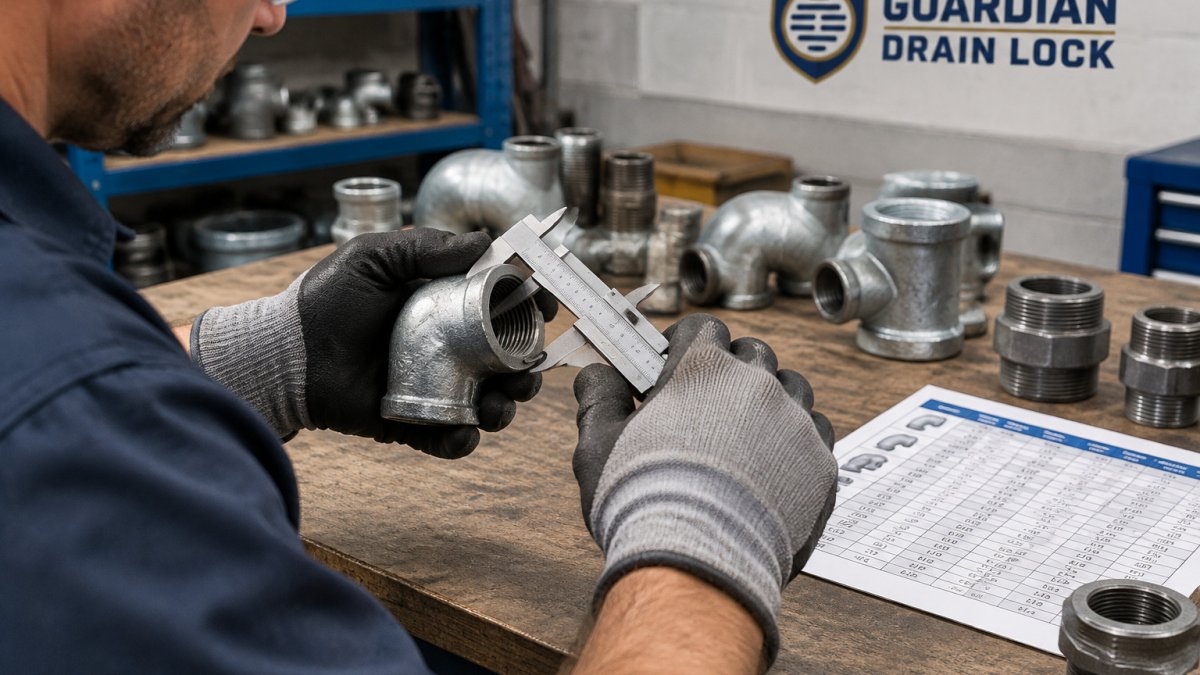
Measure the real opening when you are replacing an existing fitting. Nominal labels and actual dimensions do not always line up, especially across different material standards. A simple caliper check prevents ordering a fitting that fits the label but not the pipe.
A common mistake is mixing schedules. A Schedule 40 pipe and a Schedule 80 pipe may share the same nominal size but have different inside diameters and wall thicknesses. Confirm the schedule of your industrial pipe fittings before you order.
Reading Nominal Pipe Size and Schedule
Nominal pipe size is a reference name, not a precise measurement. For most steel pipe, the outside diameter stays fixed for a given nominal size while the wall thickness changes with schedule. That means the inside diameter, and so the flow capacity, changes with schedule.
Read both values from the pipe or its specification before you select a fitting. Then match the fitting rating to the schedule you are using.
The article's key sizing checks come down to these points.
| Check | What to confirm | Why it matters |
|---|---|---|
| Nominal size | Read from the pipe specification | Nominal is a reference name, not a measurement |
| Actual bore | Measure with a caliper | Labels and real dimensions do not always match |
| Schedule | Confirm Schedule 40 or 80 | Same nominal size can have different inside diameters |
| Wall thickness | Match fitting rating to schedule | Thickness changes with schedule |
| Outside diameter | Stays fixed for a nominal size | Keeps the fitting physically compatible |
Confirm Thread Types and Standards Before You Order
Threads are a frequent source of mismatch. Two threads can look identical and still fail to seal. NPT (National Pipe Taper) is the common standard in US plumbing and industrial work, while BSP (British Standard Pipe) appears on many imported fittings.
Check the thread standard, the taper, and the thread count before ordering. Mixing NPT with BSP can cause galling, leaks, or a joint that will not tighten fully.
- Confirm the thread standard on both sides of the connection
- Check whether the fitting uses a tapered or parallel thread
- Note any sealant or gasket requirement for the chosen standard
For welded, compression, or flanged connections, confirm the flange class or compression standard as well. Compatibility matters more than appearance.
Check Standards, Traceability and Common Selection Mistakes
Ask your supplier for material certificates and traceability records. Certificates confirm the alloy, heat number, and the standard the fitting was made to. This paperwork matters for audits, insurance, and any repair that follows a failure. A certificate that does not match the marked heat number on the fitting is a red flag, not a paperwork formality.
Several standards govern industrial fittings, and each covers a different part of the requirement. ASME B16 specifications define dimensions, pressure classes, and marking for fittings and flanges. ASTM specifications define material composition, mechanical properties, and test methods for the metal or plastic used. ASME B31 piping codes address how the system is designed, installed, and tested. The ASME Codes and Standards overview describes how these specifications are organized.
Rather than treating standards as background reading, verify compliance in a fixed order:
- Identify the project specification or jurisdictional requirement that applies to your facility and service.
- List the specific standard editions and material specifications the project calls out.
- Confirm the fitting's marking and certificate reference those exact standards and editions.
- Check that dimensions, pressure class, and material match the specification, not just the catalog description.
- File the certificates with the installation record so inspection and repair can trace them later.
Common selection mistakes to avoid:
- Choosing a material without checking the process fluid
- Ignoring temperature derating on the pressure rating
- Mixing thread standards at the same joint
- Ordering by nominal size without checking the schedule
- Skipping certificates for regulated applications
- Accepting a certificate that does not match the fitting's heat number or marking
Many buyers also overlook lifecycle cost. A cheaper fitting that corrodes in two years often costs more than a better material that lasts a decade once you count downtime, labor, and replacement. Compare initial purchase cost against installation, maintenance, and expected service life rather than price alone.
Plan Your Next Fitting Order and Installation Check
Put the selection steps into a written checklist before you buy. Record the medium, temperature, pressure, material, size, schedule, thread standard, and required certificates. A checklist lets a second person verify the order and cuts costly returns.
After installation, inspect each joint for leaks and check that supports carry the load. Recheck the system after the first pressure test and again after the first thermal cycle. Problems often appear once the line heats up or cools down.
If you are adding floor drain protection as part of a larger commercial project, Guardian Drain Lock offers basket accessories for standard floor sinks that can be planned alongside your fitting order. For drains in service areas, it also helps to review how floor sinks are protected before you finalize the layout.
For sizing questions, you can also learn how to measure the actual drain opening before ordering. Pricing depends on quantity, delivery timing, and configuration, so request a current quote from Guardian Drain Lock before you commit to a purchase.
Frequently Asked Questions
How do I tell what size pipe fitting I need?
Start with the nominal pipe size (NPS) of the pipe, not its actual outside diameter, because fittings are sold by nominal size. Measure the outside diameter of the existing pipe or check the pipe schedule stamped on it, then compare that to a pipe fitting size chart. Confirm the connection type and thread standard at the same time, since a correctly sized fitting with the wrong thread will still leak. When replacing a fitting, bring the old part or its markings to your supplier to verify the match before ordering.
Is Schedule 40 the same as standard pipe?
For most nominal sizes, Schedule 40 and Standard Weight (STD) carry the same wall thickness, so they are generally interchangeable in practice. The labels come from different specification systems, and the match holds for common carbon steel sizes up to 10 inches. Always confirm the specific wall thickness on the pipe and the fitting rating, especially in high-pressure service, before assuming two schedules or designations match.
How do I check whether a pipe fitting meets the required standard?
Look for markings on the fitting body and packaging that identify the manufacturing standard, material grade and pressure rating. Request a mill test report or material certificate from your supplier for critical service, and check that the fitting's thread standard matches the mating component. Documentation that ties a fitting to a recognized ASME or ASTM specification gives you traceability for inspections and audits.
How do I match a pipe fitting to the system's pressure and temperature?
Find the maximum operating pressure and temperature of your system, including any pressure spikes, then select a fitting whose pressure rating meets or exceeds those values at that temperature. Pressure ratings drop as temperature rises, so a fitting rated at room temperature may not be suitable for hot process lines. Build in a safety margin and confirm the rating with the manufacturer's published tables.
