

How to Measure for Floor Sink Baskets: A Step-by-Step Guide
Quick Summary
To measure for floor sink baskets, measure the actual drain opening, not the pipe size or label. For a square sink, record width, length and depth; for a round sink, record diameter and depth. Check whether the sink is tapered by comparing rim and bottom measurements, then match your numbers to the basket's listed dimensions.
- Measure the actual drain opening, since labels and real openings often differ.
- Square sinks need width, length and depth; round sinks need diameter and depth.
- Check that the two opening measurements of a square sink are within a quarter inch.
- Compare rim and bottom measurements, since a half inch difference means a tapered sink.
- Size tapered sinks to the rim and confirm the basket depth against the shallowest taper.
Table of Contents
- Why Correct Floor Sink Basket Sizing Matters
- Tools You Need Before You Measure
- Measuring Floor Drains for Drain Locks: Step by Step
- Tapered vs. Straight-Wall Sinks: How to Tell the Difference
- Commercial Floor Sink Basket Dimensions and Common Sizes
- How Your Basket Choice Helps Prevent Grease Buildup in Floor Drains
- Booking Your Guardian Drain Lock Basket Order
- Frequently Asked Questions
Why Correct Floor Sink Basket Sizing Matters
Last Updated: November 4, 2026
A floor sink basket that is even slightly the wrong size will not sit correctly in the drain. Food scraps, grease and debris then find a way past it and into the plumbing. Guardian Drain Lock builds drain protection for restaurants, hospitals, schools and factories, and a basket that was ordered by guesswork and never fit the floor sink underneath is a common cause of trouble. Knowing how to measure for floor sink baskets prevents that mistake and saves a service call.
Measuring is not complicated, but it does require precision. Floor sink sizes are often listed by their nominal size, and the real opening can be different. Floor sink baskets are sold in a range of standard sizes, and the listed size and the actual opening can differ. Those small differences decide whether a basket seats properly.
Sizing matters for three practical reasons:
- A snug fit keeps solids where they belong. Gaps let debris slide past the basket.
- A proper fit lets the basket be removed for cleaning. A basket that jams is often pried out or left out entirely.
- The right depth protects the trap. Debris that bypasses the basket can block the P-trap and cause costly backups.
The rest of this guide walks you through what to gather, how to take the measurements, how to tell a tapered sink from a straight-wall sink, and how to choose the right basket order.
Tools You Need Before You Measure
Gather a few simple tools before you start. You do not need specialized equipment, but accurate numbers depend on having the right ones on hand.
- A steel tape measure that reads in inches and fractions of an inch
- A flashlight to see the inside edge of the sink and the flange
- A notepad or phone to record each measurement as you go
- A clean cloth and a brush to clear grease and debris from the rim
- Gloves for handling a dirty drain
Clean the rim and the inside wall before you measure. Grease and food residue can add a fraction of an inch that throws off the reading. If the basket is being replaced, take it out and check its dimensions as a reference. Keep the tape square to the opening and read the measurement at eye level to avoid parallax error.
Measuring Floor Drains for Drain Locks: Step by Step
Measure the actual drain opening, not just the pipe size or the label on the old part. Step-by-step measuring guide covers the process in more detail. Labels and real openings do not always match. Start by clearing the drain, then follow the steps for your sink shape below.
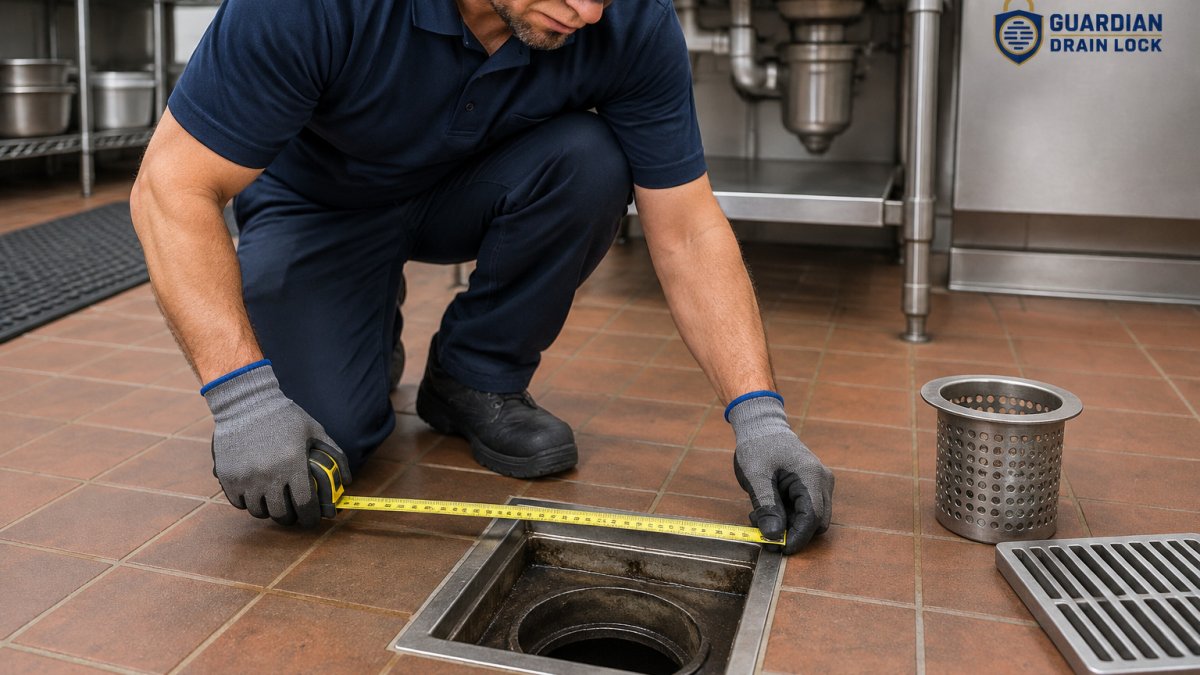
Measuring a Square Floor Sink
- Measure the width of the opening from one inside edge to the opposite inside edge.
- Measure the length the same way, perpendicular to the width.
- Measure the depth from the top of the rim down to the bottom of the sink.
- Record all three numbers in the order width x length x depth.
Check that the two opening measurements are close to equal. If they differ by more than a quarter inch, measure again, because the sink may be out of square or the rim may have been damaged.
Measuring a Round Floor Sink
- Measure straight across the opening through the center to get the diameter.
- Measure in a second direction at a right angle to the first to confirm the number.
- Measure the depth from the top of the rim to the bottom of the sink.
- Record the diameter and depth.
Use the larger of the two diameter readings if they differ slightly. A round basket that is a touch too small will fall through or wobble, so it is safer to round toward the wider measurement when the two numbers disagree.
Tapered vs. Straight-Wall Sinks: How to Tell the Difference
Many floor sinks are not straight all the way down. Some narrow as they go deeper, which is called a tapered sink. Others keep the same opening size from rim to bottom, which is a straight-wall sink. This matters because the basket must match the shape it sits in, and most guides skip this step entirely. Getting it wrong is one of the most common reasons a basket that measured correctly at the rim still will not seat.
To tell them apart:
- Measure at the rim and again at the bottom. If the opening is noticeably smaller at the bottom, the sink is tapered.
- Look at the walls with a flashlight. A visible slope or step inside the sink usually means taper.
- Compare the rim to the bottom with a tape. A difference of even a quarter inch is enough to affect fit.
- Check the corners. A square sink with rounded or chamfered lower corners is often tapered even when the walls look vertical.
For a tapered sink, measure the opening at the rim, since that is where the basket will seat. Choose a basket that fits the rim opening and check that the depth clears the taper. A basket that is deep enough for a straight-wall sink can bottom out early in a tapered one, leaving the rim standing proud and the basket unstable. For a straight-wall sink, the rim and bottom measurements should match, and the basket can be sized from either point.
Watch out: a basket that fits the rim but is too deep for the taper will sit high, and one that is too shallow will drop below the rim and let debris pass over the top. Record the rim opening, the bottom opening and the depth together so the taper is captured in your notes.
A simple way to account for taper is to subtract the bottom measurement from the rim measurement. If the difference is a half inch or more across the opening, treat the sink as tapered and size the basket to the rim while confirming the depth against the shallowest point of the taper.
If you are measuring several sinks in one facility, note the taper on each one separately. Tapered and straight-wall sinks are often mixed in the same kitchen, and a basket that fits one will not necessarily fit the next.
The table below compares how the rim and bottom readings should be used for each sink shape.
DUO 2-in-1 Floor Sink Basket - 9.5 inch Round →
| Sink shape | Measure at | Basket sizing rule |
|---|---|---|
| Tapered | Rim opening | Size to rim; check depth against shallowest taper |
| Straight-wall | Rim or bottom | Rim and bottom measurements should match |
| Taper indicator | Rim minus bottom | Half inch or more across opening means tapered |
| Taper depth check | Depth vs. taper | Too deep sits high; too shallow drops below rim |
Commercial Floor Sink Basket Dimensions and Common Sizes
Floor sink baskets come in standard sizes, and most commercial drains use a small set of them. Knowing the common sizes helps you match your measurements to a product quickly, but the listed size and the actual opening are not always the same number.
Commonly sold sizes include:
- 8.5" x 8.5" x 3" square baskets
- 10" x 10" x 5" square baskets
- Round baskets sized to the diameter of the opening, commonly 9.5" and 10"
Because sinks are often labeled by nominal size, always compare your measured opening to the basket's listed dimensions. A sink's labeled size may differ from its actual opening, and a basket's listed size may differ slightly from its true dimensions. Measure the opening, then read the product's actual dimensions, not its nominal label.
If your measurements fall between two standard sizes, choose the one that fits the actual opening and check the depth. Do not force a larger basket into a smaller opening. A basket that is a quarter inch too wide will not seat, and one that is a quarter inch too narrow will shift and let debris past the edge.
For a round sink, the DUO 2-in-1 Floor Sink Basket - 9.5 inch Round is a useful option. It is a two-basket system that lets you pull solids out while the primary basket stays in place, which makes cleaning faster in busy kitchens. Its baskets are made of glass filled polypropylene and feature alternating strainer sizes, with the top basket catching larger particles and the bottom basket catching smaller debris.
For a square sink, the DUO 2-in-1 Floor Sink Basket - 8.5 inch Square uses the same two-basket design. Both models are listed at $42.37 each, and both are built to keep solids out of the drain.
When a standard basket will not work, custom sizing is the next step. Sinks that are out of square, cast with an unusual taper, or fitted with a nonstandard flange often fall outside the common sizes. In those cases, record the rim opening, the bottom opening, the depth and the flange width, and source a basket fabricated to those numbers rather than forcing a universal size.
Watch out: do not assume two sinks of the same nominal size share an opening. Manufacturers vary, and older sinks may have been regraded or repaired. Measure each opening before ordering, especially when replacing baskets across a whole facility.
How Your Basket Choice Helps Prevent Grease Buildup in Floor Drains
Grease can contribute to floor drain problems in commercial kitchens, since it cools and sticks to pipe walls and traps food solids.
A basket that fits well can catch solids before they reach the trap and the grease trap downstream.
The DUO baskets use two strainers with different filter sizes, with the top basket catching larger particles and the bottom basket catching smaller debris. The primary basket can stay in place while the top basket is removed for emptying.
Booking Your Guardian Drain Lock Basket Order
Start by confirming the opening size, the shape and the depth against the product listings. Compare the square and round options to see which matches your sink.
You can browse the full range of floor sink baskets to find the size that fits your measurements. If you want to see every option in our product line, the Guardian Drain Locks collection lists the complete range.
Keep your measurement notes with your order. If you are fitting several drains in a facility, record each opening separately, since sizes often vary from one sink to the next. Accurate numbers at this stage prevent returns and make installation faster.
Frequently Asked Questions
How do I determine the correct size floor sink basket?
Measure the inside diameter or the inside width and length of the floor sink at the top of the opening, not the outside of the flange. Then compare those figures to the basket dimensions listed for the product. Round-sink baskets are sized by diameter, while square sinks are sized by width and length, so confirm which measurement the listing uses before you order. If a measurement falls between two sizes, check the manufacturer's guidance, since rounding rules differ between suppliers.
What are the standard dimensions for commercial floor sink baskets?
Because actual sizes vary by sink model, always verify the basket's listed dimensions against your own measurements.
Do I need to measure the inside or outside of the floor sink?
Measure the inside of the floor sink opening. The basket sits inside the sink body, so its fit depends on the interior diameter or interior width and length. Outside measurements include the flange and lip, which can be wider than the opening the basket must fit into. Measure the lip and flange separately only if your product listing asks for them, since they help confirm how the basket seats.
What is the difference between a floor sink basket and a dome strainer?
A floor sink basket is a cylindrical or box-shaped strainer that sits down inside the sink to catch food solids, sediment and debris. A dome strainer is a shallower cover that rests over the drain opening. Baskets hold more debris between cleanings and are the usual choice for floor sinks in commercial kitchens. Check your sink type and debris load before choosing between them.
