

Reduce Hazardous Waste Costs: A Step-by-Step Guide
Last Updated: November 4, 2026
Quick Summary
The most effective way to reduce hazardous waste costs is to audit what you produce, keep hazardous and non-hazardous waste strictly separate, and stop waste at its source. Mixing waste makes an entire load chargeable as hazardous, so careful segregation is the cheapest control available.
- Run a waste audit for two to four weeks to map every waste stream and its cost.
- Mixing hazardous and non-hazardous waste classifies the whole volume as hazardous.
- Keep containers closed, label them clearly, and track accumulation start dates.
- Size containers to accumulation limits so pickups are not scheduled on nearly empty drums.
- Compare vendors on total annual cost, including stop fees, surcharges and minimum charges.
Table of Contents
- Step 1: Run a Waste Audit to Map Your Waste Streams
- Step 2: Segregate Hazardous From Non-Hazardous Waste
- Step 3: Apply Hazardous Waste Minimization at the Source
- Step 4: Meet Hazardous Waste Storage Requirements
- Step 5: Route Universal Waste Through Lower-Cost Disposal
- Step 6: Pursue Hazardous Waste Recycling and Reuse, Then Compare Vendors
- Keeping Your Hazardous Waste Budget Under Control With Guardian Drain Lock
- Frequently Asked Questions
Hazardous waste disposal is one of the costliest line items many facilities never track closely, and hazardous waste costs often go unexamined until an invoice spikes. At Guardian Drain Lock, we see how small drain and waste habits quietly drive up the bill. Waste audits show that 30-50% of landfill waste can often be diverted to recycling or composting, which points to real savings for most facilities (Dyrt's 2026 guide to reducing waste disposal costs). The same logic applies to hazardous streams, where the first savings usually come from knowing what you produce and keeping it apart.
The reason costs add up is simple. Mixing hazardous waste with non-hazardous waste causes the entire volume to be classified and charged as hazardous. One wet rag soaked in solvent can turn a cheap load into an expensive one. Facilities that route solids, grease and chemicals through the same drain or bin pay for that mistake every pickup.
Drains make this worse. When a floor sink has no working strainer, rags, bags and food solids reach the pipe and cause clogs. Cabling to clear them can damage P-traps, and the repair bill is often larger than the original waste problem. Floor sink basket product page is one way to keep solids out of the line in the first place.
- Solids that reach the drain cause clogs and emergency plumbing calls
- Mixed waste streams push a whole load into the hazardous category
- Damaged P-traps add repair costs on top of disposal fees
The fix is a process, not a single purchase. The steps below walk through it in order.
Step 1: Run a Waste Audit to Map Your Waste Streams
A waste audit shows exactly what leaves your facility, in what volume, and at what cost. Start by listing every waste stream: solvents, aerosols, lab chemicals, universal waste like lamps and batteries, and everyday solids.
Weigh or count each stream for two to four weeks. Record the container type, the pickup frequency and the vendor invoice. Many facilities discover that one stream drives most of the spend.
- Log every container and its contents
- Record pickup frequency and cost per pickup
- Flag any stream that could be non-hazardous if kept separate
Step 2: Segregate Hazardous From Non-Hazardous Waste
Segregation is the cheapest cost control you have. Keep hazardous and non-hazardous materials in separate, clearly labeled containers from the point of generation.
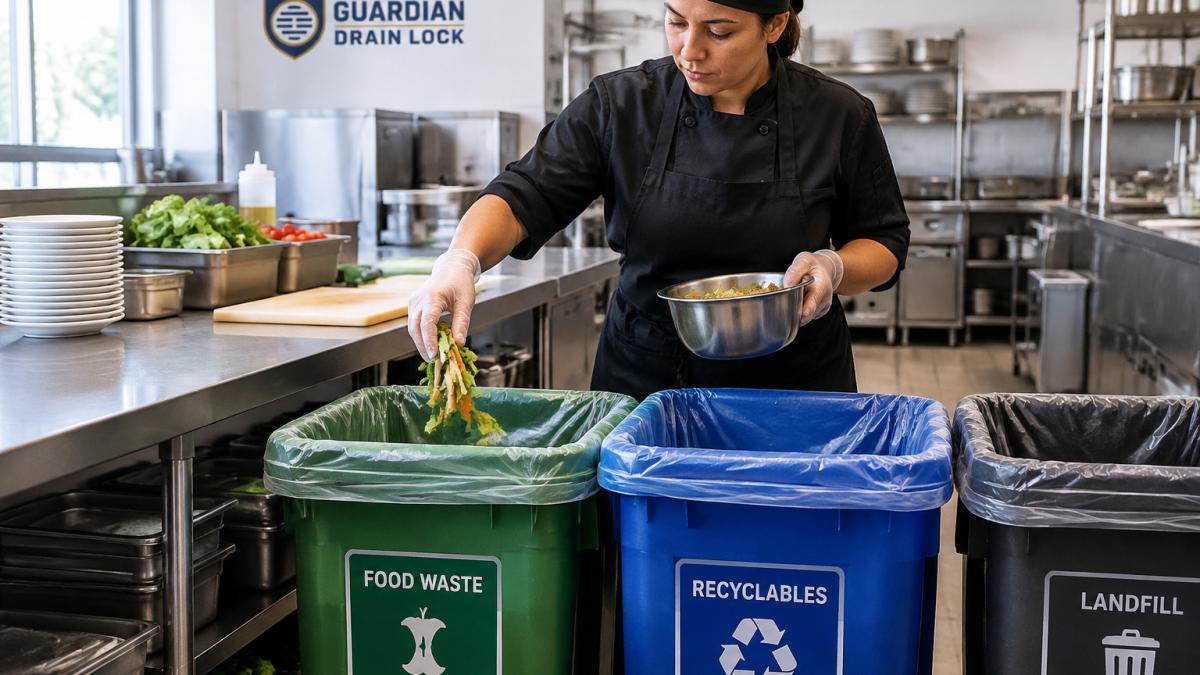
Place labeled bins near the work areas where waste starts. Train staff to put rags, gloves and wipes in the correct bin before they leave the station. At drains, a basket keeps solids out of the line, so they never mix with wastewater. Floor sink baskets come in sizes that fit standard floor sinks. Floor sink basket product page works well in square floor sinks for this purpose.
Step 3: Apply Hazardous Waste Minimization at the Source
Waste minimization means producing less hazardous waste in the first place. Source reduction in materials and processing is a primary method for cutting hazardous waste generation (ScienceDirect review on hazardous waste source reduction).
Focus on three moves: buy only the quantity you will use, substitute less hazardous materials where the process allows, and keep containers closed to prevent spills. Stopping solids and fats at the drain also cuts waste, since every clog removed is material you no longer have to manage. A practical guide to preventing commercial drain clogs covers the materials that cause them. Disposable drain socks catch solids before they enter the pipe (Drain socks product page). Disposable drain socks are a simple capture option for solids and FOG at the source.
Step 4: Meet Hazardous Waste Storage Requirements
Storage rules affect cost because a violation can bring fines, forced emergency pickups, and higher insurance or permitting scrutiny. Under federal rules, generators are classified by monthly output, very small quantity generators (VSQGs), small quantity generators (SQGs), and large quantity generators (LQGs), and each class sets limits on how much waste you can accumulate and for how long. Check your generator status with the U.S. Environmental Protection Agency and your state environmental agency, since states can add stricter rules (EPA hazardous waste generator requirements).
How storage rules translate into disposal cost
Accumulation-time limits are the hidden cost driver. Smaller generators face looser accumulation rules than larger ones, and the exact limits depend on your generator class and state rules, so confirm them with the EPA and your state agency. When you bump against a time limit, you schedule a pickup whether or not the drum is full, and partial pickups are where stop fees and minimum charges eat the budget. The practical move is to size containers and pickup frequency so drums fill before the clock runs out, not after.
- Keep containers closed except when actively adding waste
- Label each container with contents and the accumulation start date
- Store in a designated area with secondary containment
- Inspect on a set schedule and keep a written log
Match container size to accumulation limits
Facilities sometimes buy large drums for a stream that produces only a few gallons a month, then pay a full pickup fee on a nearly empty drum to meet an accumulation deadline. Smaller containers or consolidation of compatible streams into one drum can cut pickup frequency without violating limits. Confirm with your vendor which streams can be consolidated and which must remain segregated by waste code.
Watch out: mixing incompatible wastes or losing the accumulation start date can reclassify a load and trigger a violation, and a forced emergency pickup typically costs far more than a scheduled one.
Keep the paperwork audit-ready
Inspection logs and manifests are the records regulators typically request, and missing records can lead to penalties. A simple binder or digital log per storage area, signed and dated at each inspection, costs little and prevents the expensive outcome of a failed inspection. If your state requires biennial reporting or annual waste reports, build the data capture into the same log so reporting season does not become a scramble.
DUO 2-in-1 Floor Sink Basket - 9.5 inch Round →
The storage rules below set how long and how much waste you can accumulate, so they shape your pickup costs.
| Generator class | Basis | Storage implication |
|---|---|---|
| Very small quantity generator (VSQG) | Monthly output | Looser accumulation rules |
| Small quantity generator (SQG) | Monthly output | Limits set by generator class |
| Large quantity generator (LQG) | Monthly output | Strictest accumulation rules |
| Accumulation time limit | Set by generator class and state | Partial pickups drive stop fees |
| Compatible streams | Waste code | Consolidation can cut pickup frequency |
Step 5: Route Universal Waste Through Lower-Cost Disposal
Universal waste, such as lamps, batteries and certain electronics, can follow simpler handling rules than full hazardous waste.
Sort universal waste into its own labeled containers, track accumulation dates, and confirm with your vendor that it is handled under universal waste rules. Mixing universal waste into general hazardous containers removes this advantage.
Step 6: Pursue Hazardous Waste Recycling and Reuse, Then Compare Vendors
Recycling and reuse can turn some waste streams into recovered value, and certain recovery methods can reduce the volume you pay to dispose of. Once your streams are separated, profiled, and reduced, the vendor comparison becomes far more accurate, and far more negotiable.
Build a bid package before you call anyone
Most facilities accept the first quote because they have nothing to compare it against. Before you solicit pricing, assemble a bid package that forces vendors to quote apples to apples:
- Audited annual volumes by waste stream, with EPA waste codes and physical form
- Container sizes and current pickup frequency per location
- Generator status and any accumulation-time constraints
- Site access details (dock hours, manifest handling, training requirements)
- Which streams you are willing to consolidate and which must stay separate
Send the same package to at least three permitted treatment, storage, and disposal facilities (TSDFs) plus any regional haulers that broker to them. Ask each to price per drum, per pickup, and per manifest so you can see where the money actually goes.
Negotiate on the levers that move price
Disposal pricing is not fixed. The line items that respond to negotiation are usually transportation, fuel and environmental surcharges, stop fees, and minimum pickup charges, not the base treatment rate. Practical levers include:
- Volume commitment: Offer a guaranteed annual volume in exchange for a rate hold or a cap on surcharges.
- Consolidation: Fewer, fuller pickups cut stop fees and fuel charges; ask what volume triggers a lower per-drum rate.
- Contract term: Multi-year terms often buy rate protection, but insist on a cap on annual escalators.
- Rebates and recovery credits: If a stream has recovery value (spent solvents, metals-bearing waste), ask how that value is credited back to you.
- Manifest and paperwork fees: Ask these to be waived or bundled, since they are administrative, not treatment, costs.
Watch out: a low per-drum rate can hide high stop fees, minimum pickup charges, and surcharges that reverse the savings at your actual pickup frequency, always compare total annual cost at your audited volumes, not the headline drum price.
Run the ROI before you sign
Justify the change to finance with a simple annualized calculation rather than a vague "it saves money" claim:
Annual savings = (current total annual cost) − (proposed total annual cost) − (one-time transition costs)
Include one-time costs such as new labeled containers, secondary containment, staff training hours, and any re-profiling or lab analysis fees. Divide annual savings by one-time costs to get a payback period in months. The payback period depends on your own invoices, so run the math on your actual costs rather than assuming a result.
- Base quotes on your audited volumes and stream profiles
- Compare total annual cost, including surcharges and stop fees
- Ask about consolidation triggers, minimums, and recovery credits
- Calculate payback in months before committing to a term
Keeping Your Hazardous Waste Budget Under Control With Guardian Drain Lock
Hazardous waste costs come down when you know your streams, keep them separate, and stop waste at the source. Drain protection is part of that work, because solids that stay out of the line never become a clog or a repair bill. Guardian Drain Lock's tamper-resistant locks and baskets help restaurants, hospitals and schools keep solids where they belong. Start with the Guardian Dome D-LOCK locking drain lock for floor sinks that staff tend to disturb, and review the full range to protect every drain in your facility.
Frequently Asked Questions
What are some ways to reduce hazardous waste?
The most effective ways are source reduction, substituting less hazardous materials, buying only the quantities you need, and keeping hazardous materials out of general waste. Source reduction, which targets how waste is generated in the first place, is a primary method cited in hazardous waste research. Combined with a waste audit, these steps show where your largest, most expensive waste streams come from and which ones you can eliminate or shrink.
How does separating hazardous waste reduce disposal costs?
Mixing hazardous waste with non-hazardous waste can cause the entire volume to be classified and charged as hazardous, which raises disposal fees significantly. Keeping streams separate means only the truly hazardous portion is treated at premium rates. Clear labeling and staff training at each collection point make segregation hold up day to day.
Can recycling or reuse lower hazardous waste disposal costs?
Yes. Recycling, reclaiming solvents, and reusing materials reduce the volume that must be sent to a treatment, storage, and disposal facility (TSDF), and that volume is what drives your bill. Some waste streams can be recovered on site or sent to recyclers at lower cost than disposal. Compare each option against your current disposal fees before committing.
How can a waste audit help lower hazardous waste disposal costs?
A waste audit records what you generate, where it comes from, and what it costs to remove. A review of hazardous streams can show which items can be substituted, consolidated, or eliminated. Use the audit to rank waste streams by annual cost and tackle the most expensive ones first.
